


Can you improve his gait?
PM&R News • March 2018
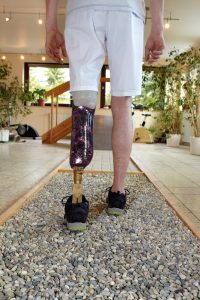
A 63-year-old male comes from his rural home to your big city practice with a chief complaint of “I just want to walk normally again!”. You learn that he had a traumatic tractor accident 5 years ago which resulted in a left below the knee amputation. He was fitted with a transtibial prosthesis but has never really been happy since it was fitted. He received a polycentric hydraulic swing/stance control device but has loss of balance often with heel contact of the prosthetic limb. He often feels he is walking on a tight rope and reports skin breakdown at the proximal medial border of the prosthesis against his residual limb and the distal lateral side of residual limb. You watch him walk and it appears as if he scissors at times and he does have a loss of balance with a near fall. You remove his prosthesis and you see non-blanching erythema at the two areas he mentioned above. In addition, his distal limb has a warty like appearance and is moist.
What adjustments can you make to his prosthesis to correct his gait pattern? Will this improve his skin concerns or do you need to make other adjustments? What is the warty skin change?
Review Question
You make an adjustment and laterally set the foot. If it is set too laterally, what would you see?Answer
You would expect the opposite of the patient’s initial presentation. You would see a medial thrust at the proximal brim. The patient would develop skin concerns at the medial distal aspect of the socket and the lateral proximal aspect of the socket.
