


MSK Ultrasound: A Good Investment?
PM&R News • February, 2018
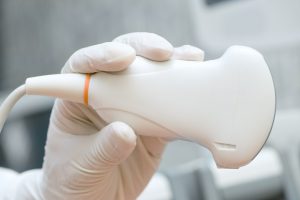
When it comes to MSK ultrasound, are you an early innovator or prefer to wait until this modality becomes more mainstream?
I wrestled with deciding to become proficient at MSK ultrasound. Being a physiatrist, I think we take a certain amount of pride in performing the best and most comprehensive MSK physical exams. In addition, we know our landmarks and are certain that our intervention is targeted towards our desired anatomical area.
While that has some merit (cough…cough… no bias here!), no physical exam is 100% sensitive and specific, anomalies do exist, and being able to actually see underneath the skin offers tremendous benefit. It’s one thing to note a positive empty can test, but it’s another to actually be able to see and quantify a supraspinatus tear immediately during a new patient visit. Immediately, you can choose to send a younger patient to surgery, or formulate a rehabilitation plan to help your patient best recover. Without the use of readily available MSK ultrasound, treatment is delayed while waiting for the much more expensive MRI, or therapy is directed towards an incorrect diagnosis.
Another interesting aspect about MSK ultrasound is that you can inspect, palpate, look at the joints and tendons under ROM, evaluate the neurovascular structures and even perform special physical exam test (milking maneuver for UCL tear) while viewing the relevant anatomy.
While this is great, there are a few barriers to making this easy to incorporate. First, MSK ultrasound requires a ton of learning and practice, similar to EMG. Not only do you have to master anatomy, you also have to train your brain to look at structures in long-axis and short-axis views. You have to learn how to use the machine and develop coordination skills as you hold a probe while doing an interventional procedure.
Second, you probably will want to decide if this is economically beneficial for you practice. Fortunately, here is a guide from AMSSM to help you answer this question.
Finally, you have to gain the respect of your colleagues who will refer patients to you and to whom you will refer patients to. You may see an Achilles tear on MSK ultrasound, but if your orthopedic colleagues do not trust your skills, they will order an MRI anyway.
For me, MSK ultrasound is definitely worth the investment of time, money and energy. It’s a convenient, cost-effective and the appropriate imaging choice for many diagnoses and procedures. Patients are educated in their injury better, which seems to make them more involved in their recovery. So, incorporating MSK ultrasound into practice makes sense to me.
Plus, (let me state the elephant in the room) it’s just plain cool ;)
Review Question
You are ultrasounding the medial ankle. What are the structures from anterior to posterior?Answer
“Tom, Dick And Very Nervous Harry” Tibialis Posterior, Flexor Digitorum Longus, Tibial Artery, Vein, Tibial Nerve, Flexor Hallucis Longus
