


What is the Etiology?
PM&R Image • November, 2017
Here we present a case of a 63-year-old woman who presented with severe 10/10 right neck, trapezius and shoulder pain after changing out all of the light bulbs in her 8,000 square foot home. She states that she woke up with severe pain described as burning and stabbing. All movement makes the pain worse, she gets minimal relief with heat.
On exam, she is guarded. The right cervical paraspinals, trapezius, rhomboids, infraspinatus, supraspinatus and deltoid are sensitive to touch. She is reluctant to move. Upper extremity reflexes are intact and there are no long tract signs. There is no pain in the forearm or hand.
Considering there were not neurological changes, she was given trigger point injections and a course of anti-inflammatories.
She returned to clinic a few days later with minimal benefit. An x-ray was ordered as shown below:
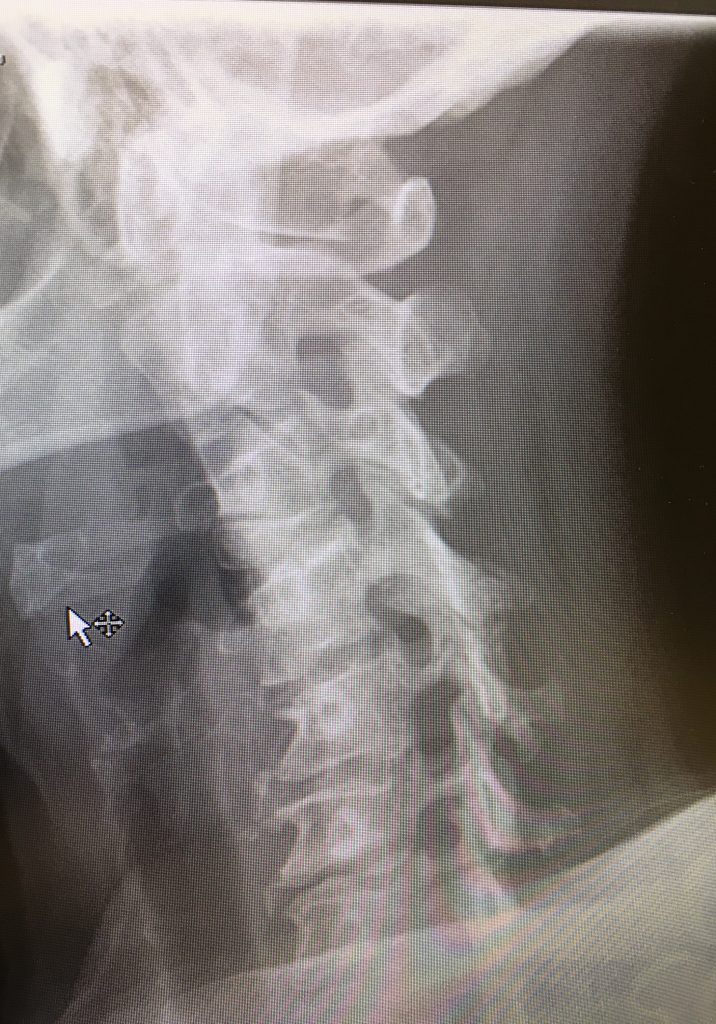
At what level is the problem most likely based on the above image?
A. C5
B. C4
C. C6
D. C7
On this right oblique cervical x-ray view, moderate to severe stenosis can be appreciated at the level of C4-C5. The question posed is to determine which nerve root exits from this level. The correct answer is the C5 nerve root that exits between C4-C5. Remember that from T1 and lower, the exiting nerve root will be associated with the level above. For example, the L5 nerve root exits between L5 and S1.
Next Steps
An MRI was ordered to confirm a severe C4-C5 far right posterolateral herniation. She was sent to PT and given gababpentin for pain control. At a 2 week follow up, pain was centralized to the right mid neck. A trigger point in the cervical paraspinals was again identified and injected with good benefit. She is now with minimal tolerable pain and back to full function.
Key Points
For Board studying, just be sure to know your disk herniation levels. In the cervical spine, use the lower segment to identify the nerve root. For example, C5-C6 = C6 nerve root. For the thoracic and lumbar spine, use the upper segment L4-L5 = L4 nerve root.
Another important point is that an L4-L5 disc herniation will actually affect the transversing nerve. So in this example, and L4-L5 herniation will affect the L5 nerve root, although the exiting nerve root is L4.
Please don’t neglect your spine anatomy, as this will surely be represented on the Boards.
Review Question
An MRI confirms a large right L2-L3 herniation. An EMG is performed. Which nerve root level will most likely be affected?Answer
In this case, the right L3 nerve will be affected, considering it is the transversing nerve root.
