


Burning Foot – A Complex Cause?
PM&R Case • October, 2017

A 17-year-old female presents to your clinic, referred to you for a burning foot. She is the star high school soccer player and recently fractured her distal tibia and required ORIF. She progressed well in 6 weeks of physical therapy and did not have any issues with recovery. At her last visit, she reported to the therapist that her left foot started to have tingling sensations in it. The therapist recommend that she start to use her crutches again until she can see her orthopedic surgeon, which took two weeks. She followed the PT recommendation. However, by the time she saw the orthopedist, she reported 10/10 burning pain and could not ambulate. She also could no longer wear a sock or shoe, as the pain was unbearable. The foot felt excessively warm and was sweaty often.
On exam, the foot was diaphoretic. The surgical wounds were healed. The left foot was 1.2 degrees Celsius warmer than the right. She was guarding the foot and would not let you touch it for more than a few seconds at a time. She was tender from the toes to the mid tibia. ROM was limited in all planes, but worse with dorsiflexion, in which she could not get to neutral. Her tibialis dorsalis pulse was strong and intact. Allodynia was severe. Strength testing of the left foot was 3-4/5 throughout. Otherwise, lower extremity strength was normal.
Initial x-rays were normal.
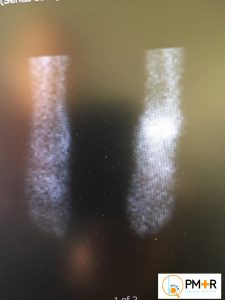
Here are the findings of the triple-phase bone scan:
 Diagnosis
Your patient was subsequently diagnosed with Complex Regional Pain Syndrome Type I. She was given a steroid taper dose. In addition, the importance of weight-bearing, desensitization exercises and contrast baths was stressed. She was sent to a physical therapist with knowledge in treating CRPS, type I.
Two weeks later she was seen in follow up. She ambulated in the clinic without an assistive device and pain is now a 1/10. On exam, both feet look similar with the exception of very mild edema and atrophy of the left foot. Temperatures were similar.
We present this case as an excellent study case for Complex Regional Pain Syndrome, Type I – a high yield topic.
Here is a helpful review that we recommend browsing prior to your exam.
Review Question
What is CRPS Type II?Answer
CRPS Type II specifically occurs after a peripheral nerve injury.
